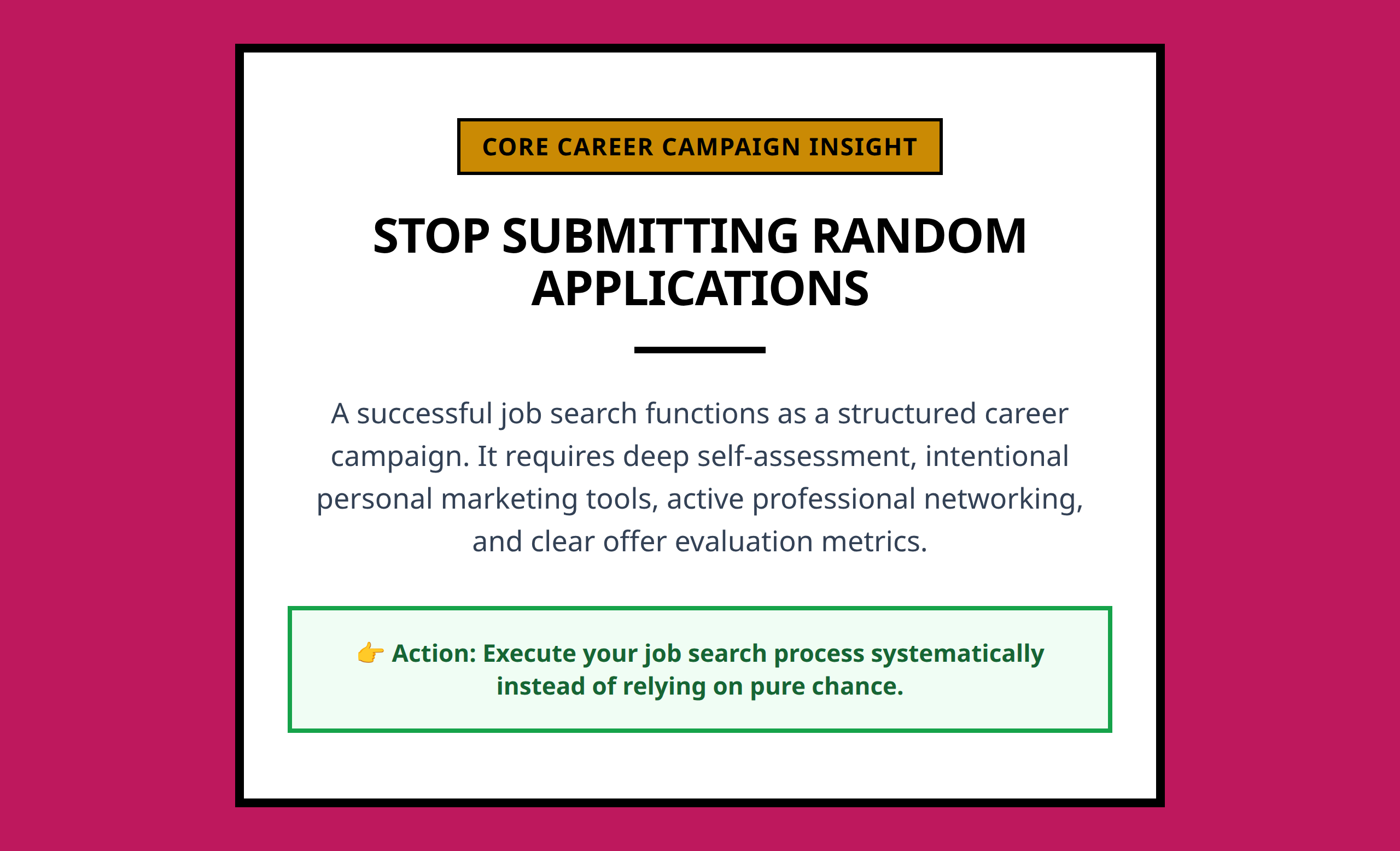
The job search process works best when it is treated as a structured career campaign rather than a series of random applications. By understanding each stage—from self-assessment through workplace success—you can make better decisions, present yourself more effectively, and improve your chances of finding the right opportunity.
I often notice that people approach job searching as if success depends mainly on finding the right job posting. While opportunities matter, a strong job search usually begins much earlier. It starts with understanding yourself and building a plan.
A successful career campaign follows a clear sequence: self-assessment, marketing strategy, marketing tools, interview preparation, interviewing, follow-up, offer evaluation, and long-term career success. Each step supports the next. Skip one, and the entire process becomes harder.
Takeaways
- Start with self-assessment before writing a resume or applying for jobs.
- Think of yourself as a product that must be marketed effectively.
- Networking and personal marketing often create opportunities that applications alone cannot.
- Interview success depends heavily on preparation done beforehand.
- The job search process continues even after accepting an offer.
Why Job Searching Is a Personal Marketing Campaign
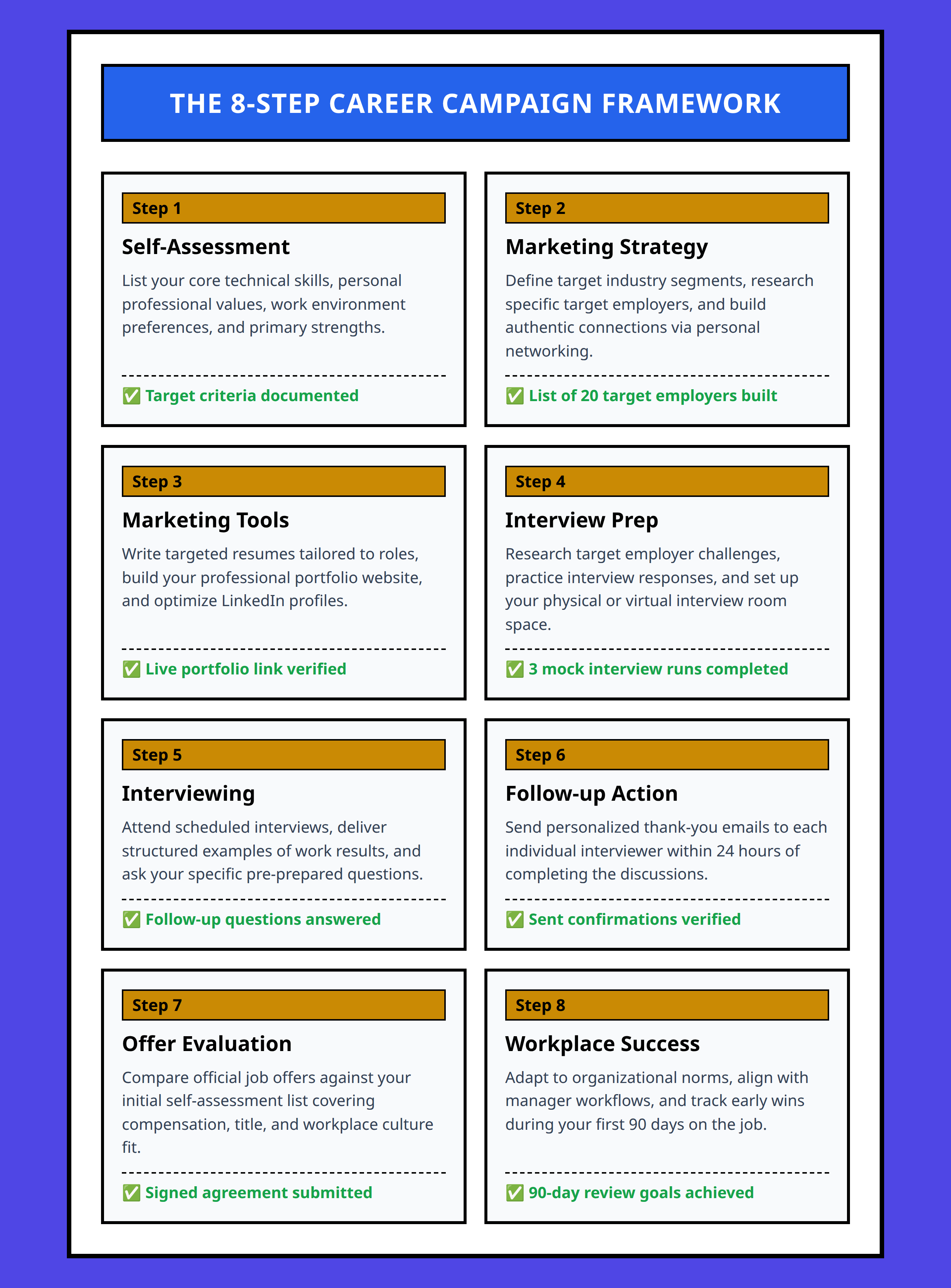
The most useful way to think about a job search is as a personal marketing campaign. Employers are making decisions about whom to hire, and they evaluate candidates based on value, fit, and presentation.
Marketing traditionally focuses on four elements: product, place, promotion, and price. Applied to a career search, these ideas become surprisingly practical.
- Product: Your skills, abilities, experience, and strengths.
- Place: The locations, industries, and employers where you want to work.
- Promotion: Your resume, portfolio, networking activities, and interview performance.
- Price: Your compensation expectations and the value you bring to an employer.
Many job seekers focus almost entirely on promotion. They spend hours revising a resume while giving little attention to understanding their strengths, identifying target employers, or developing a realistic salary strategy. A balanced approach usually produces better results.
Personal marketing also involves consistency. If your resume emphasizes problem-solving skills, your networking conversations, portfolio examples, and interview answers should reinforce that same message.
The Eight Steps of a Successful Career Campaign
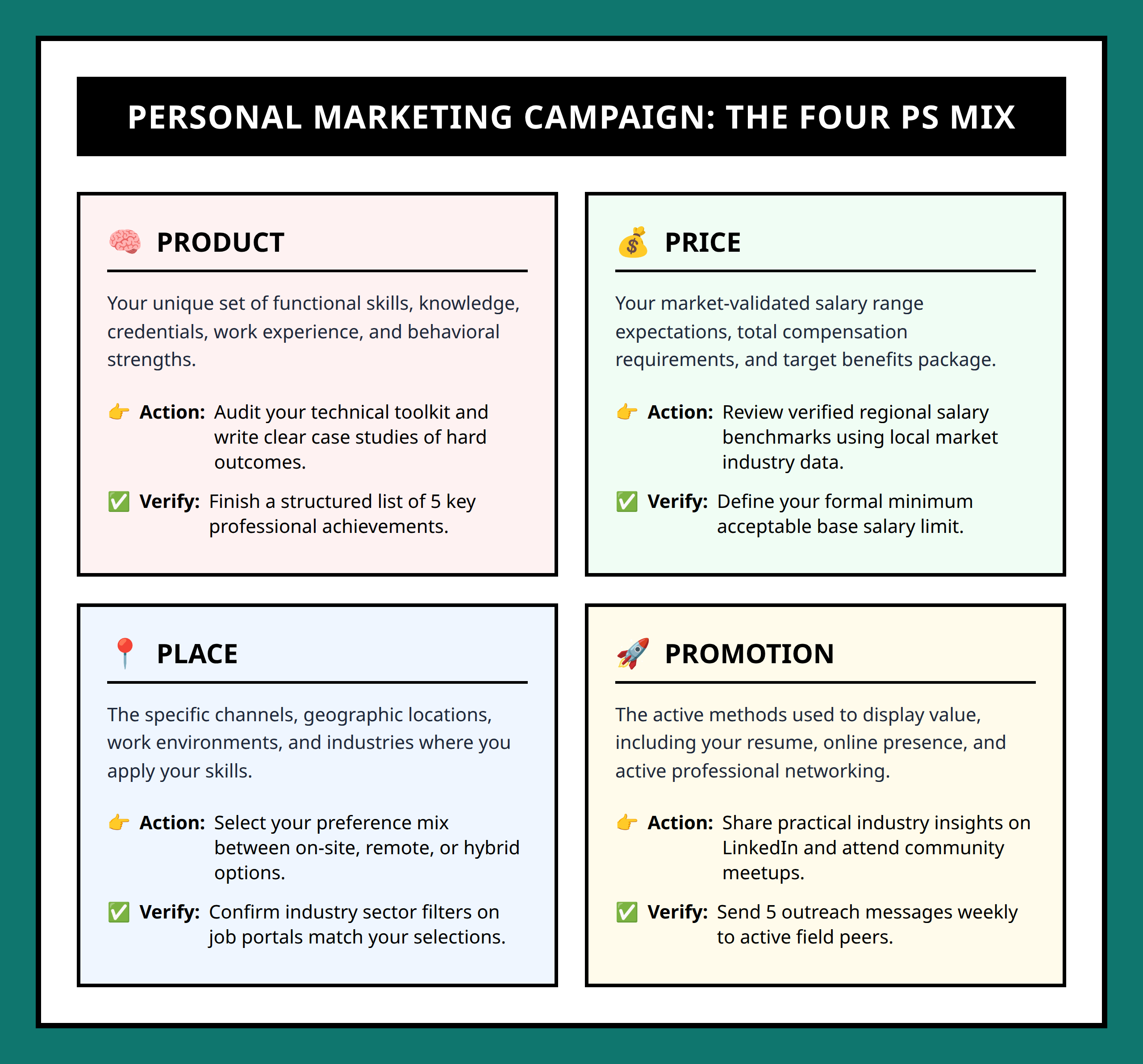
The job search process becomes easier to manage when viewed as a series of connected steps.
| Step | Primary Focus |
|---|---|
| 1 | Self-assessment and goal setting |
| 2 | Marketing strategies and networking |
| 3 | Creating marketing tools |
| 4 | Interview preparation |
| 5 | Interview execution |
| 6 | Interview follow-up |
| 7 | Job offer evaluation |
| 8 | Career success after hiring |
Step 1: Perform Self-Assessment
The first step is understanding yourself. This includes identifying your abilities, transferable skills, personal strengths, work preferences, and career goals.
For example, someone who enjoys independent work, problem-solving, and detailed analysis may thrive in a different environment than someone who prefers teamwork, frequent interaction, and public-facing responsibilities.
Without this foundation, later decisions often become guesswork.
Step 2: Develop Marketing Strategies
Once you understand what you offer, you need a strategy for reaching potential employers. This includes networking, informational interviews, researching organizations, and identifying opportunities that align with your goals.
Rather than waiting for opportunities to appear, effective job seekers actively create connections and gather information.
Step 3: Create Marketing Tools
Your marketing tools communicate your value to employers.
- Resume
- Cover letter
- References
- Professional portfolio
These materials should support the same professional message and highlight the strengths identified during self-assessment.
Step 4: Prepare for Interviews
Preparation is one of the most important predictors of interview success.
This stage includes researching employers, understanding the position, preparing responses to likely questions, selecting appropriate attire, and developing thoughtful questions to ask.
A candidate who spends time preparing usually communicates more confidence and professionalism.
Step 5: Handle the Interview Effectively
The interview is often the most visible part of the job search process, but it works best when supported by the previous steps.
Strong interviews combine preparation, communication skills, examples of past accomplishments, professionalism, and the ability to demonstrate fit for the role.
Step 6: Follow Up After the Interview
Following up shows professionalism and continued interest.
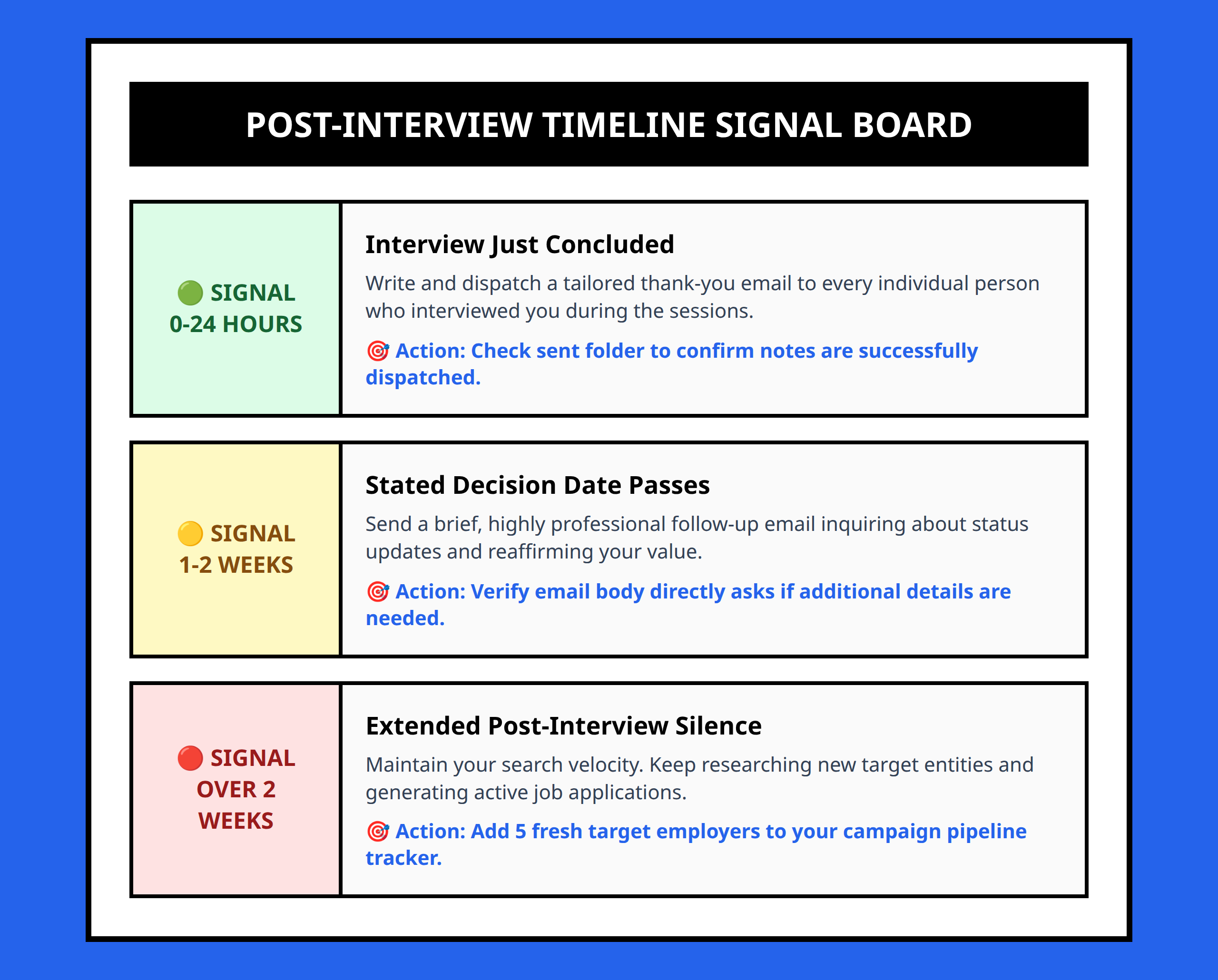
This stage may include thank-you messages, reflecting on interview performance, and evaluating how well the opportunity matches your goals.
Step 7: Evaluate the Job Offer
Receiving an offer is not necessarily the final decision point.
Consider factors such as responsibilities, compensation, growth opportunities, work environment, and overall fit. A job that looks attractive initially may not support your long-term goals.
Step 8: Focus on Career Success
The career campaign does not end once you start work.
Long-term success involves fitting into the organization, building relationships, learning workplace expectations, continuing skill development, and adapting to new responsibilities.
Common Job Search Mistakes That Slow Progress
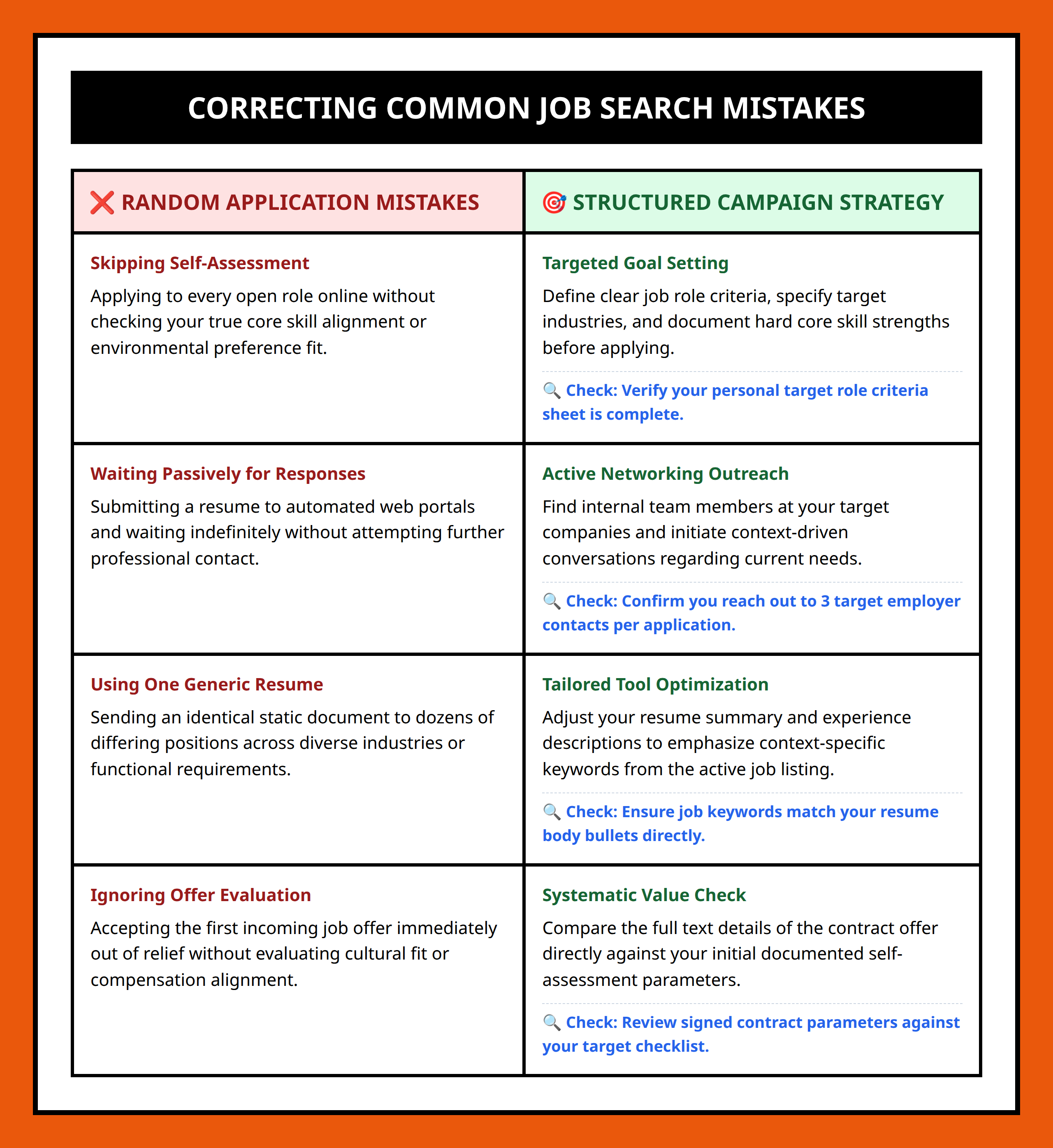
The most common job search mistakes usually occur when people skip foundational steps.
Waiting Passively
One of the biggest mistakes is posting a resume online and waiting for responses. While online applications have a role, relying on them exclusively often produces disappointing results.
Active networking, company research, and direct outreach generally create more opportunities.
Skipping Self-Assessment
Many candidates rush directly into resume writing without clearly identifying their strengths, skills, and goals.
This often leads to generic applications that fail to distinguish the candidate from others.
Weak Personal Promotion
Some people possess valuable skills but struggle to communicate them.
Imagine two candidates with similar qualifications. One clearly explains accomplishments, demonstrates preparation, and presents a consistent professional message. The other provides vague answers and relies on employers to discover strengths independently. The first candidate will usually have an advantage.
Ignoring Long-Term Career Goals
Accepting the first available opportunity without evaluating fit can create future dissatisfaction.
Career decisions work best when they support both immediate employment needs and longer-term professional objectives.
Why the Process Works Better as a System
The most important lesson is that each step strengthens the next one.
Self-assessment improves marketing. Marketing improves networking. Networking supports interviews. Interviews lead to offers. Thoughtful evaluation leads to better career choices.
When viewed as a complete system rather than isolated activities, the job search becomes more organized, more intentional, and often more successful.
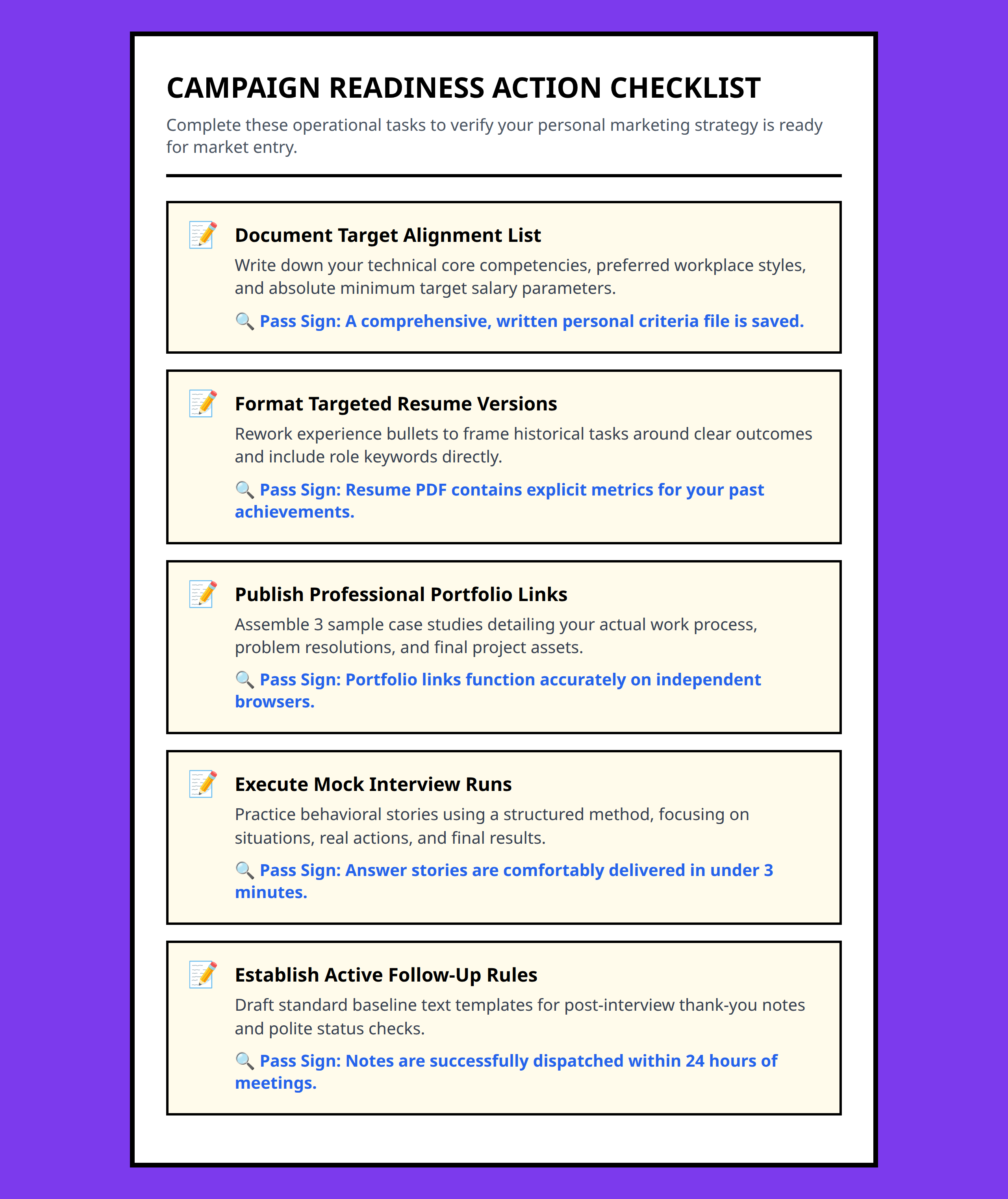
If you want a practical next step, spend thirty minutes creating a simple career campaign plan. Write down your strengths, target employers, networking activities, and interview preparation goals. That single exercise can bring more clarity than sending dozens of applications without a strategy.
FAQ
- Personal Marketing: The process of presenting your skills, abilities, and value to potential employers.
- Career Campaign: A structured approach to finding, securing, and succeeding in employment.
- Transferable Skills: Skills that can be applied across different jobs, industries, or career paths.
- Portfolio: A collection of work samples, achievements, and supporting materials that demonstrate professional ability.
- Networking: Building and maintaining professional relationships that may provide information, guidance, or opportunities.
References:
- https://www.linkedin.com/posts/sarahdjohnston_job-searching-can-feel-like-gloom-and-doombut-activity-7440383708718739457-IhlT
- https://aakashgupta.medium.com/complete-job-search-framework-that-actually-gets-interviews-aa8dfacebd2d
- https://www.foundit.sg/career-advice/career-planning-guide-singapore/
- https://www.jobs-me.com.sg/blog/your-step-by-step-job-search-process
- https://open.umn.edu/opentextbooks/textbooks/six-steps-to-job-search-success
- https://www.spencerstuart.com/research-and-insight/six-steps-for-a-successful-job-search
- https://www.content.mycareersfuture.gov.sg/job-searching-4-steps-guide/
- https://www.linkedin.com/posts/acwdb_seven-steps-in-a-successful-job-search-activity-7409256368752222208-5ir_
- https://sg.indeed.com/career-advice/finding-a-job/advanced-job-search-guide
- https://parwcc.com/5-steps-to-rapid-employment-a-proven-blueprint-for-job-seekers-and-career-coaches/
