Money affects career decisions psychologically as much as financially. People often experience money not simply as income, but as safety, identity, status, freedom, approval, power, guilt, or emotional survival. That is why vocational decisions around money can feel far more emotionally intense than they appear on the surface.
I think many professionals quietly assume their career conflict is practical when it is actually symbolic. They tell themselves they are deciding between a stable salary and meaningful work, but emotionally the situation often feels much larger than that.
A career choice may trigger fears about becoming invisible, irresponsible, dependent, unsuccessful, or trapped. Another person may feel guilty for wanting money at all because they associate meaningful work with sacrifice or moral purity. Someone else keeps chasing higher income long after basic security is satisfied because achievement and self-worth have become psychologically fused together.
Money decisions rarely stay only about money.
Takeaways
- Money carries emotional and symbolic meaning beyond practical survival.
- Career anxiety around income often reflects deeper fears about identity, worth, freedom, or security.
- Some people organize vocation around scarcity, approval, or status without fully realizing it.
- Money conflicts can create repetitive career patterns and chronic dissatisfaction.
- Understanding the psychology of money changes how vocational decisions are interpreted.
Why Career Decisions Become So Emotionally Charged Around Money
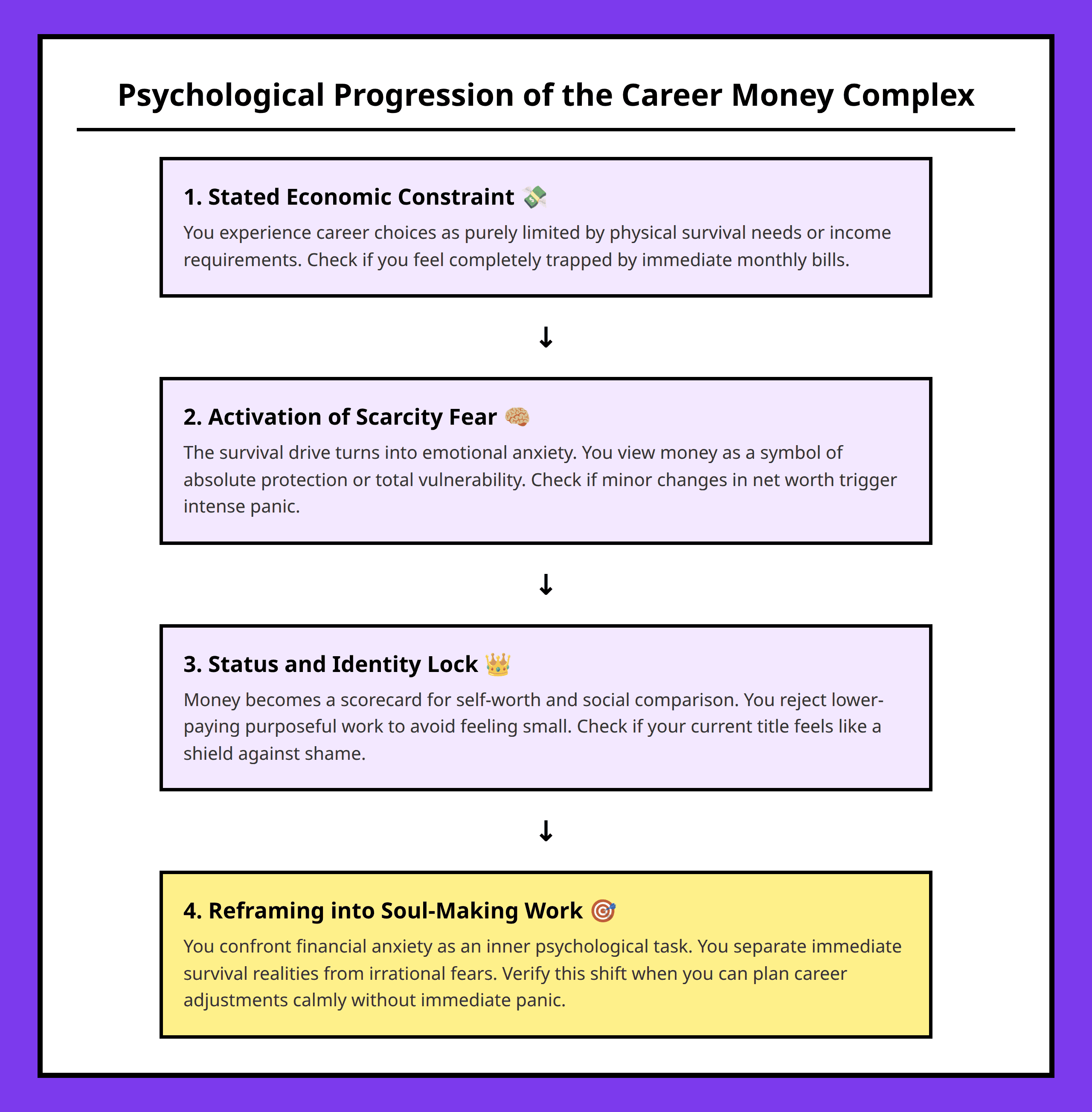
I would start by questioning the assumption that people make career decisions rationally.
Most professionals can explain their choices logically after the fact. They mention stability, opportunity, growth, compensation, flexibility, or market demand. Those factors matter. But underneath the practical explanation, money often carries emotional meanings that shape perception long before conscious reasoning begins.
A person considering a lower-paying but meaningful role may suddenly feel overwhelming anxiety even when they have savings and reasonable security. Another remains in emotionally deadening work because the thought of reduced income feels psychologically unbearable. Someone else becomes obsessed with earning more despite already living comfortably.
I do not think these reactions are explained by economics alone.
Money frequently becomes attached to emotional survival itself.
A realistic example appears in many mid-career professionals today. Someone working in a well-paid corporate role begins feeling deeply disconnected from the work. They imagine moving toward teaching, counseling, design, nonprofit work, or a slower form of professional life. Yet each time they consider change, intense fear appears immediately.
The fear may sound financial on the surface, but psychologically the person may also fear loss of identity, status, competence, admiration, or protection from uncertainty.
Money Often Functions Like Emotional Security
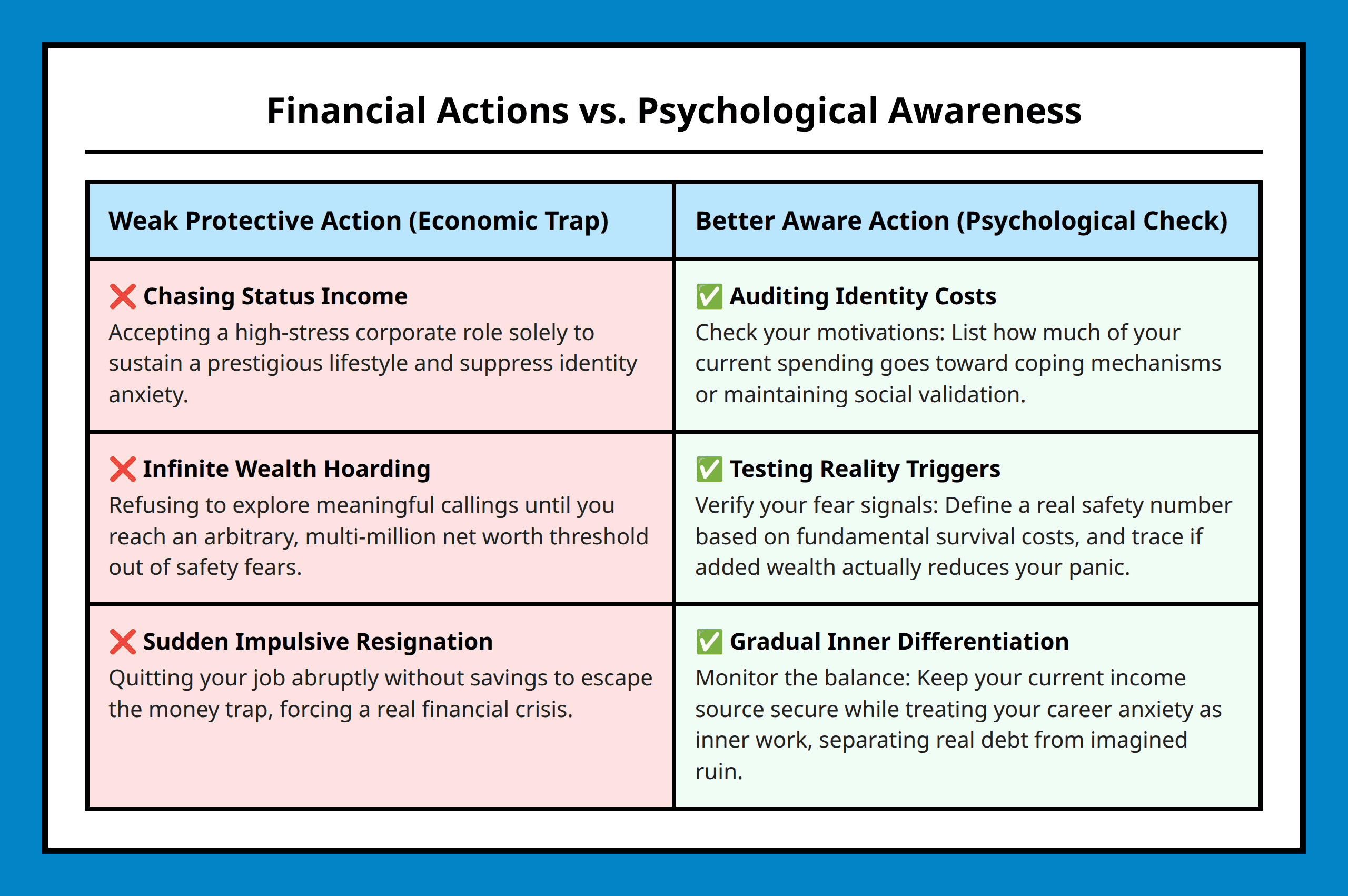
I think one of the most important points people miss is that money easily becomes symbolic protection against vulnerability.
For some people, financial accumulation creates emotional reassurance because early life felt unstable, unpredictable, or emotionally unsafe. Others associate income with independence because dependence once felt humiliating or dangerous. Another person experiences money as proof of worth because achievement became tied to love or approval growing up.
Once these emotional meanings attach themselves to money, career decisions become psychologically amplified.
A person may stay inside a draining work environment for years because the salary feels emotionally protective. Someone else may reject meaningful opportunities automatically because lower income activates deep fears about instability or failure.
I would pay attention when career decisions start feeling emotionally absolute:
- “I can’t afford to leave,” even when the situation is survivable
- “I need to make more before I can relax”
- “I would feel like a failure if I earned less”
- “Meaningful work sounds irresponsible”
Those statements often reveal symbolic meanings operating underneath the financial reasoning.
Status Anxiety Changes the Meaning of Success
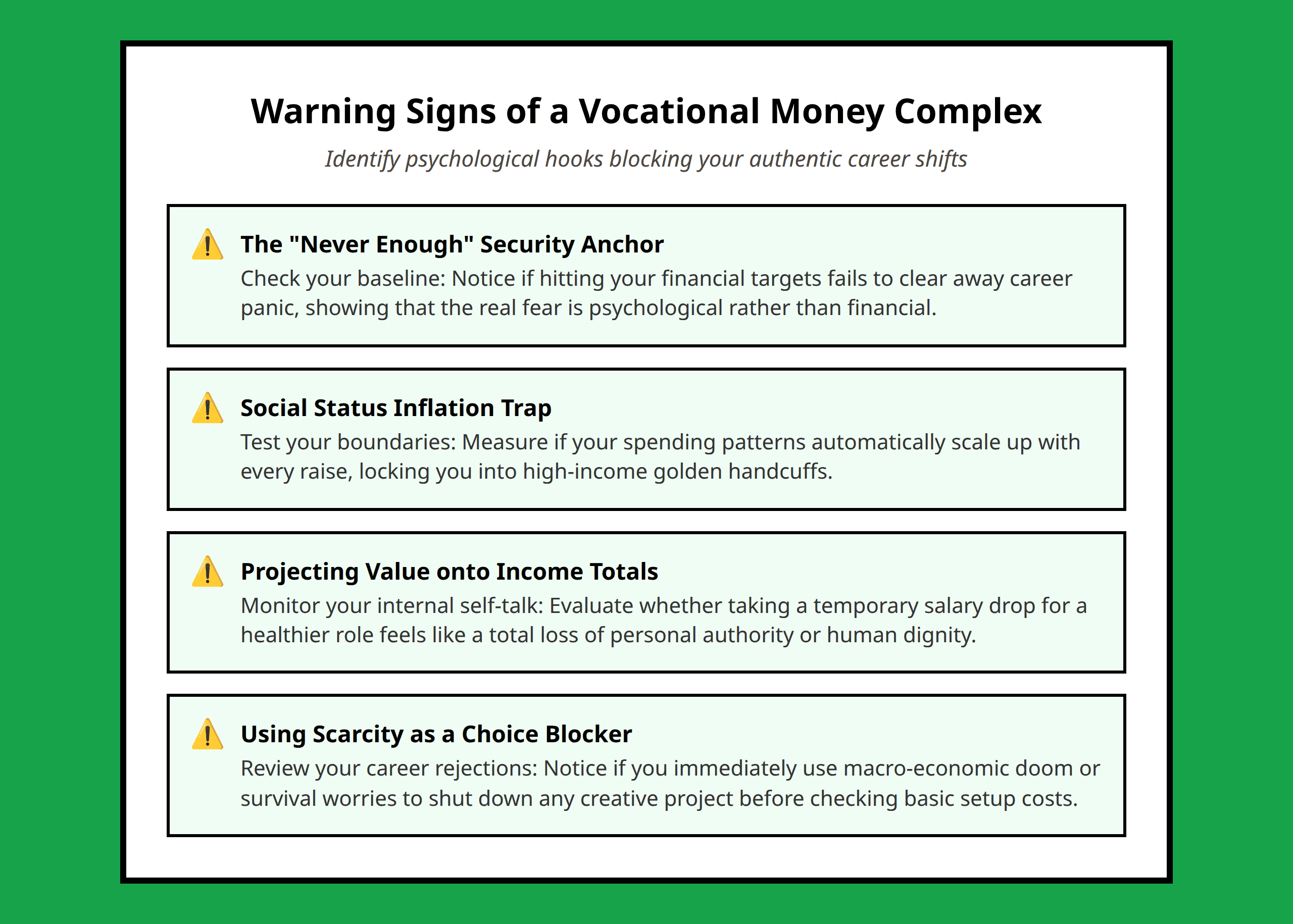
Money also carries social meaning.
I think many career decisions become distorted because income quietly functions as a measure of identity and value inside modern culture. People compare salaries, lifestyles, titles, neighborhoods, vacations, and visible success constantly, even when they pretend not to care.
That pressure changes vocational life.
A person may continue pursuing high-paying work long after the work itself stops feeling meaningful because status has become emotionally addictive. Another may reject work they genuinely care about because it feels socially inferior. Someone else becomes trapped between outward success and inward emptiness because admiration from others temporarily regulates self-esteem.
I would not reduce this to simple vanity.
Status anxiety often reflects fear of exclusion, invisibility, or loss of belonging. Human beings are social creatures. Career identity becomes psychologically powerful partly because it affects how people feel seen by the world.
A common modern situation illustrates this clearly. Someone works in a respected profession that sounds impressive at social gatherings but privately feels emotionally exhausted and disconnected. Every time they imagine leaving, another thought appears immediately: “What would people think?”
The conflict is no longer only vocational. It becomes existential and relational at the same time.
Scarcity Can Become a Vocational Pattern
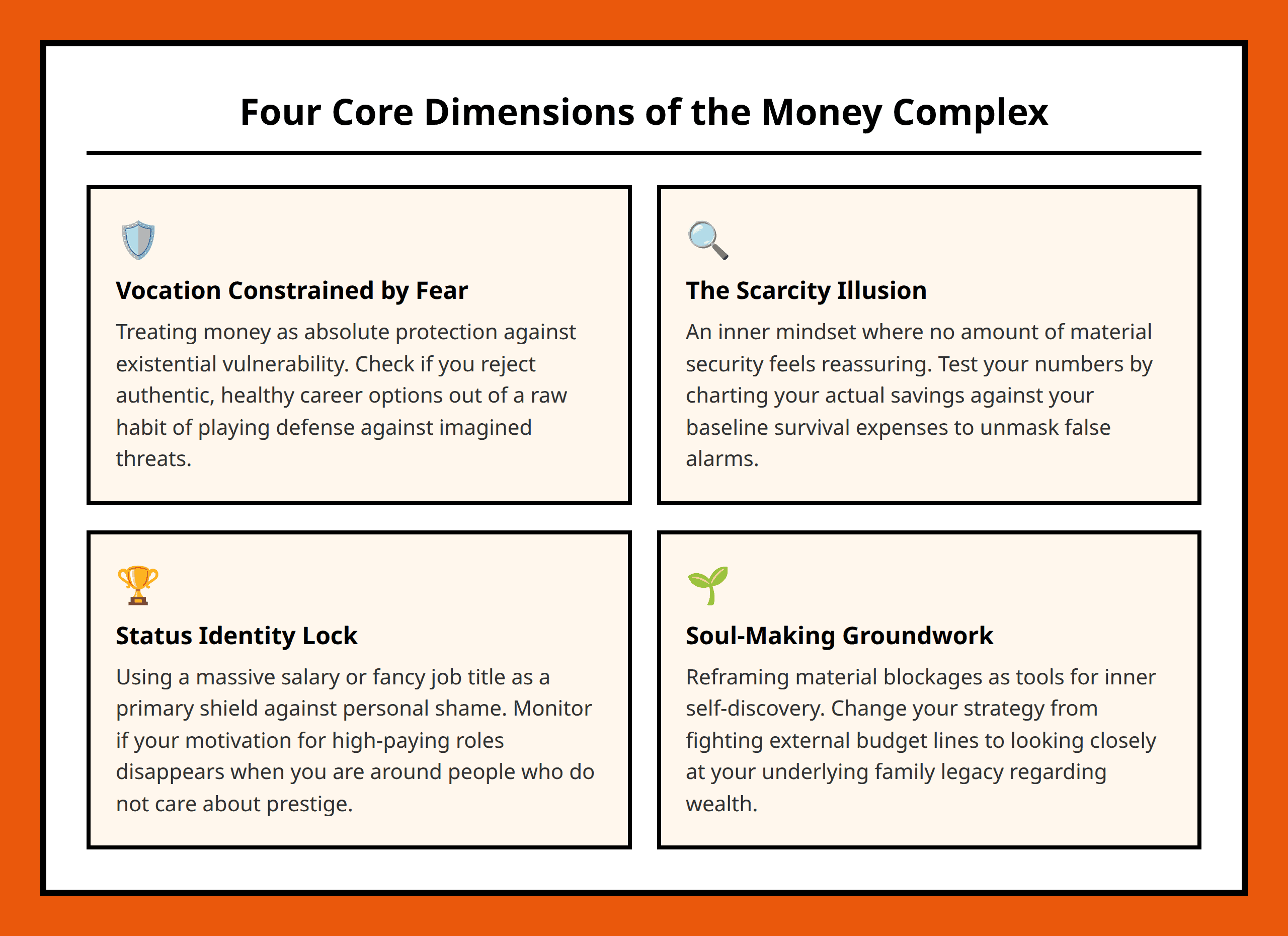
I think scarcity deserves attention not only as a financial condition but also as a psychological orientation.
Some people organize their entire vocational life around preventing imagined catastrophe. Even after reaching stability, they continue behaving as though collapse is always imminent.
This mindset shapes career behavior in powerful ways:
- avoiding meaningful risks automatically
- remaining trapped in psychologically damaging work
- overworking compulsively
- never feeling financially safe enough
- treating rest as dangerous
- equating uncertainty with disaster
I would not romanticize financial insecurity. Practical survival matters enormously.
But psychologically, scarcity can continue long after immediate danger has passed.
A person earning a strong income may still feel internally terrified of slowing down because the nervous system never fully stopped expecting instability. Another keeps chasing promotions not because additional money is necessary but because the psyche equates accumulation with emotional safety.
Without recognizing the emotional structure underneath scarcity, people often mistake compulsive fear for rational realism.
Money Can Distort the Experience of Calling
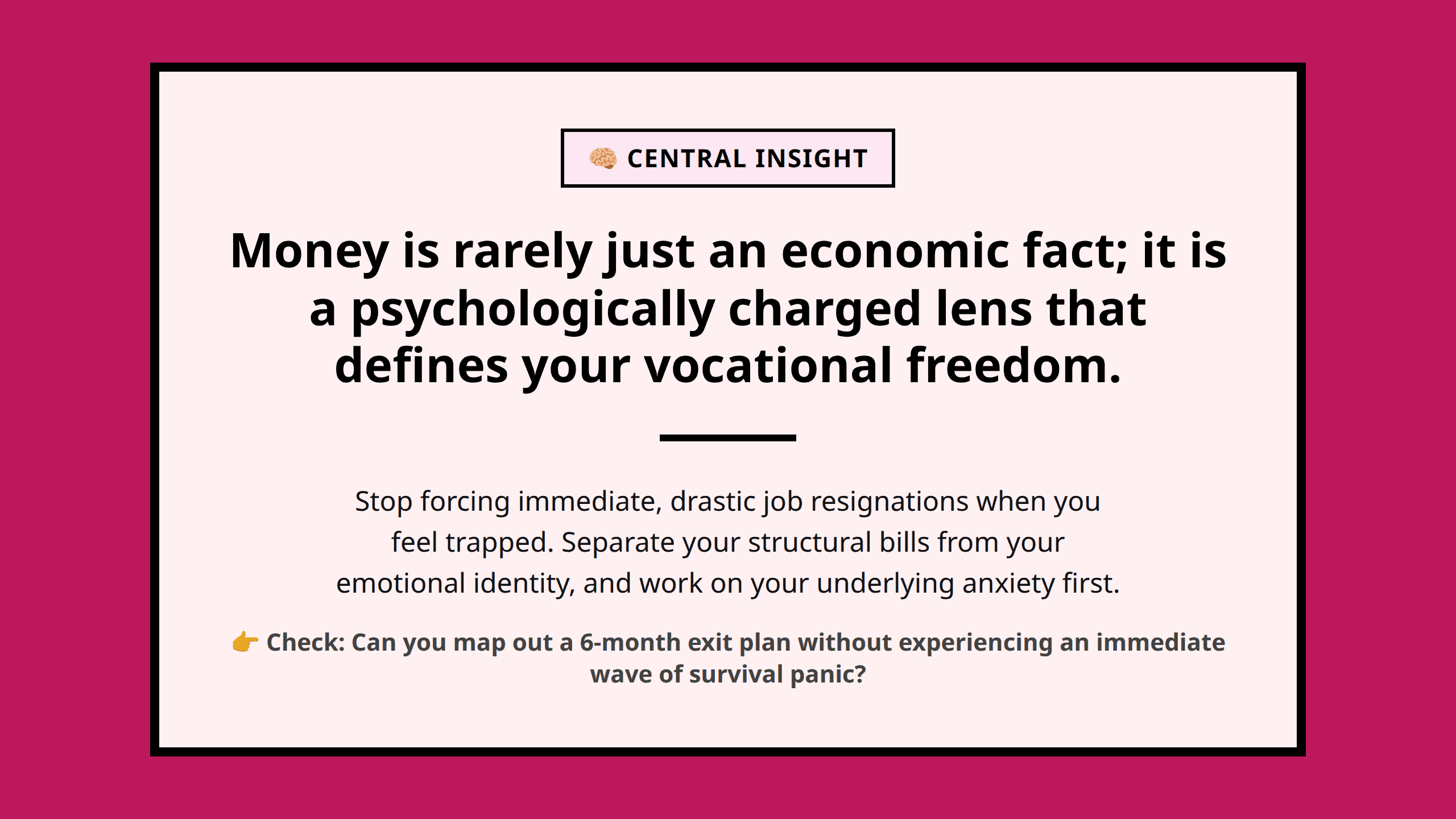
I think vocational confusion becomes especially painful when money and calling collide.
Some people become suspicious of meaningful work because they associate financial ambition with corruption or selfishness. Others move in the opposite direction and dismiss vocation entirely because practical success feels safer and more socially rewarded.
Both extremes create imbalance.
A person may quietly desire more meaningful work while repeatedly convincing themselves that emotional fulfillment is unrealistic. Another may pursue symbolic or creative work while denying legitimate financial needs until resentment and instability appear.
I would resist turning money into either a villain or a savior.
The deeper issue is whether money has become psychologically inflated.
Once money starts carrying exaggerated emotional meaning, vocational clarity becomes harder. Career choices stop reflecting only skill, interest, contribution, or meaning. They begin orbiting around fear, shame, approval, guilt, or identity preservation.
Financial Anxiety Sometimes Protects an Existing Identity
One point I find especially important is that financial anxiety can protect a familiar self-image.
A person may genuinely believe they cannot pursue different work because of money, while another part of the psyche fears what the change would reveal emotionally.
Imagine someone leaving a prestigious role for work that feels more psychologically honest but less externally impressive. The financial loss may be manageable. The deeper fear may involve becoming ordinary, disappointing family expectations, losing status, or facing uncertainty without the protection of professional identity.
I would look carefully at moments when financial reasoning feels emotionally oversized compared to the actual risk involved.
That does not mean people should ignore practical realities. It means the psyche often attaches multiple layers of meaning to money at the same time.
Career decisions become clearer once those layers are recognized separately.
Soul-Making Changes the Relationship to Money
I do not think healthy vocational development removes money concerns completely.
What changes is the relationship to them.
People begin distinguishing practical necessity from emotional inflation. They notice where money genuinely supports stability and where it functions mainly as protection for identity, fear, status, or unresolved insecurity.
I think this creates a more honest relationship to work.
A person may still choose financial stability, but the choice becomes conscious rather than compulsive. Another may pursue meaningful work while respecting material limits instead of pretending money does not matter at all.
Soul-making does not eliminate tension between vocation and income. Adult life rarely becomes that simple.
But psychological awareness changes the quality of the conflict.
The real question shifts from:
“How much money should I make?”
to something more revealing:
“What emotional role has money started playing inside my identity and career decisions?”
- Vocational conflict: Inner tension between different career desires, values, responsibilities, or emotional needs.
- Money complex: A psychological pattern in which money becomes emotionally tied to identity, fear, worth, approval, or security.
- Scarcity mindset: A persistent fear of not having enough, even when basic survival needs are already reasonably secure.
- Depth psychology: A branch of psychology focused on unconscious emotional patterns, symbolic meaning, and inner development.
- Soul-making: Psychological growth through emotional honesty, lived experience, suffering, and deeper self-awareness.
- Status anxiety: Fear related to social standing, recognition, comparison, or perceived success in the eyes of others.
References:
- https://www.mind.org.uk/information-support/tips-for-everyday-living/money-and-mental-health/the-link-between-money-and-mental-health/
- https://pmc.ncbi.nlm.nih.gov/articles/PMC8806009/
- https://psychhelp.com.au/the-psychology-of-money/
- https://harvardfcu.org/blog/the-psychology-of-money-how-biases-shape-your-financial-decisions/
- https://www.beyondblue.org.au/mental-health/financial-wellbeing
- https://greatergood.berkeley.edu/article/item/how_money_changes_the_way_you_think_and_feel
- https://www.fidelity.ca/en/insights/articles/four-reasons-behind-money-problems/
- https://lockwealthmanagement.com/the-psychology-of-money-how-emotions-affect-financial-decisions
- https://www.nhs.uk/every-mind-matters/lifes-challenges/money-worries-mental-health/
